
On this page
- The Studio Photography Invoice: What You're Actually Paying For
- Hidden Costs Nobody Puts on the Initial Quote
- AI Product Photography: The Per-Image Economics
- Real-World Cost Comparison Across Catalog Sizes
- The Category-Specific Breakdown
- When Traditional Studio Photography Still Wins
- The Hybrid Approach Most Brands Actually Use
- Turnaround Time: The Other Cost Variable
- The Scenarios Where AI Delivers Maximum ROI
- What the Numbers Actually Mean for Your Budget
- The Bottom Line: When Each Approach Makes Financial Sense
When your catalog has 500 SKUs and you're quoted $60 per image for studio photography, that sounds reasonable—until you realize the final invoice will be closer to $90-$120 per image after retouching, sample shipping, rush fees, and coordination time. Meanwhile, AI product photography vendors are delivering finished images at $0.85-$1.70 per shot, and the gap is wider than it appears.
This isn't about which method is "better"—it's about understanding what each actually costs and when each makes sense for your business. After auditing 47 enterprise photography contracts and analyzing real production data from brands at $5B retail scale, here's what product photography genuinely costs in 2026.
The Studio Photography Invoice: What You're Actually Paying For

According to data from Advertflair's audit of 47 enterprise contracts, the photographer day rate—the number most brands focus on—represents only 18% of total contract value. The other 82% is where the real cost lives, and it's structured as follows:
Studio rental and four-walls: 22% of contract value. Enterprise-spec studios in major US markets run $1,800-$4,500 per day depending on city, square footage, and equipment package. This is the largest single line item in most audited contracts, and it disappears entirely under AI product photography.
Photographer day rate: 18%. Senior commercial photographers command $2,500-$7,500 per day in 2026, varying by portfolio depth, category specialization, and exclusivity terms. This shifts to Brand DNA calibration time under AI workflows rather than vanishing completely.
Retouching and post-production: 15%. Per-image retouching for enterprise-grade hero images ranges from $8-$22 per SKU depending on complexity. At 5,000-SKU catalog scale, Advertflair found this becomes a $60K-$110K annual line item that collapses to near-zero under AI because renders arrive at hero specification.
Hidden Costs Nobody Puts on the Initial Quote

Beyond the headline rate, Kaptured's analysis identified several costs that brands discover only after signing:
Sample logistics and wardrobe handling: 12% of contract value. Moving full sample fleets in and out of studios, maintaining model-size sample sets for apparel, return shipping—especially expensive when samples cross borders. This line drops 60-80% when AI renders run from a single sample or CAD source rather than requiring full-fleet sample sets.
Shoot-day overhead: 9%. Crew meals, equipment rental beyond the studio package, insurance, transportation, miscellaneous expenses. Disappears under AI product photography.
Rush fees: 25-200% on top of base rates for fast turnaround. Kaptured notes most catalog launches end up rushed, turning a $60 quote into $75-$120 delivered.
Coordination time: 5-15 hours of internal brand-team time per shoot for briefing, sample prep, review, and revisions—a $50/hour loaded cost representing another $250-$750 nobody puts on the invoice.
AI Product Photography: The Per-Image Economics

AI product photography operates on fundamentally different economics because the cost structure is inverted. According to Kaptured's 2026 pricing data:
Software plan: $0.85 per image for a 500-SKU catalog, delivered in 2-7 days. This includes model application, scene rendering, and marketplace preset application.
Done-for-you service: $1.70 per image for the same 500-SKU catalog, delivered in 1-3 days with full quality assurance included.
The workflow that produces these numbers:
- Upload source images (vendor shots, flat lays, or mannequin shots): same day
- Apply model, scene, and marketplace preset: minutes
- Bulk generation: hours to a day for 500 SKUs—parallel processing means all SKUs render simultaneously
- QA pass: 1-2 days
- Upload: automated via API or batch download
What's notably absent: studio rental, sample shipping, photographer day rate, retouching fees, rush premiums. Nettonic's UK market analysis confirms AI removes most fixed costs entirely, which is why the first image and the hundredth image cost roughly the same to produce.
Real-World Cost Comparison Across Catalog Sizes
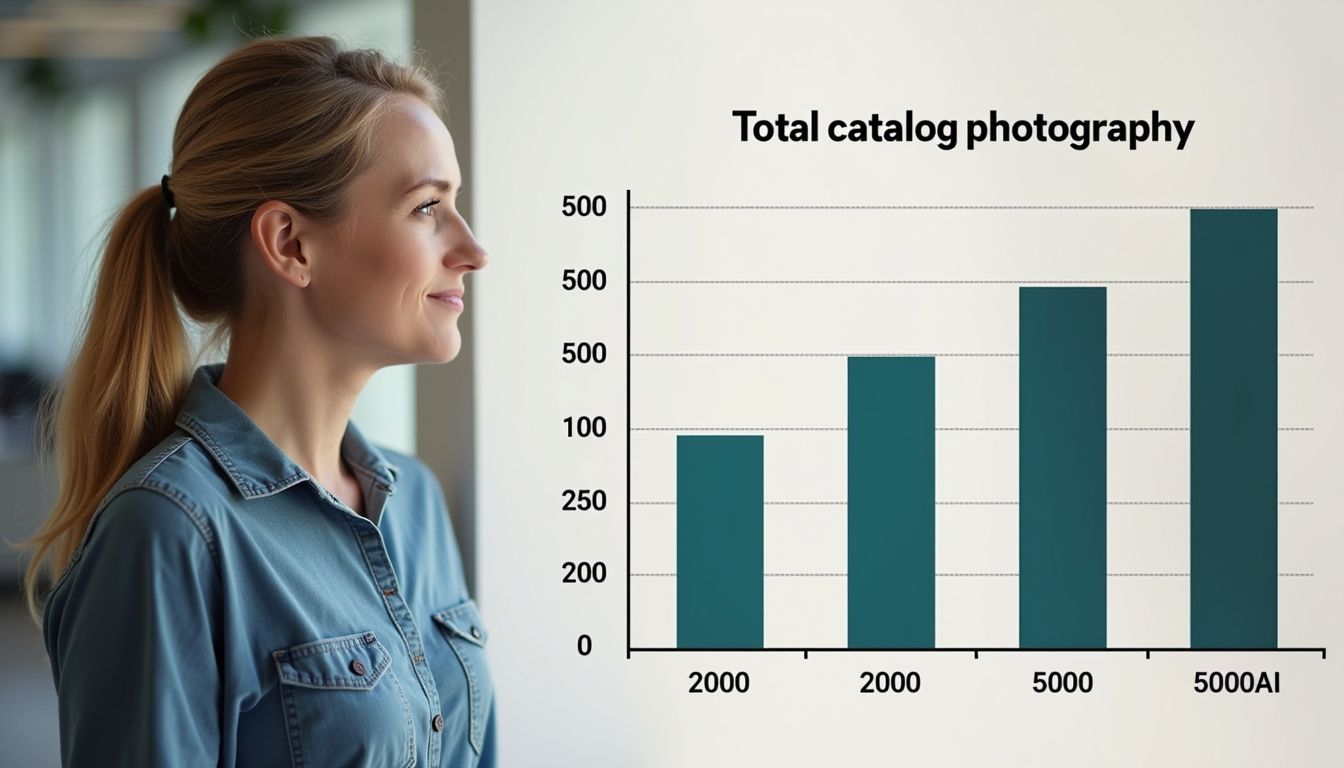
Here's what each approach costs at different scales, using Kaptured's benchmarked data:
50-SKU catalog:
- Traditional studio: $5,000-$10,000 total ($100-$200 per image effective)
- AI catalog: ~$45 total ($0.90 per image effective)
- Turnaround: 4-8 weeks traditional vs. 2-7 days AI
500-SKU catalog:
- Traditional studio + ghost mannequin: $30,000 ($60 per image quoted, $90-$120 delivered)
- AI catalog (software): $425 ($0.85 per image)
- AI catalog (done-for-you): $850 ($1.70 per image)
- Turnaround: 4-8 weeks traditional vs. 2-7 days AI
2,000-SKU catalog:
- Traditional studio: $120,000-$300,000 ($60-$150 effective per image)
- AI catalog: $1,700-$3,400 ($0.85-$1.70 per image)
- Cost ratio: 70-90% cheaper with AI
5,000-SKU catalog:
- Traditional studio: $300,000-$750,000
- AI catalog: $4,250-$8,500
- The gap widens at scale because AI costs scale sub-linearly while traditional costs remain linear
The Category-Specific Breakdown

Not all products cost the same to photograph. Advertflair's audit found significant category variation:
Apparel basics (T-shirts, denim, knits):
- Traditional: $48 per image
- AI: $19 per image
- Reduction: 60%
Jewelry and small accessories:
- Traditional: $75-$150 per image (macro photography requirements drive costs up)
- AI: $0.85-$2.00 per image
- Reduction: 95%+ (AI excels at small product rendering)
Furniture and large items:
- Traditional: $200-$500 per image (logistics and studio space requirements)
- AI: $1.50-$3.00 per image
- Reduction: 95%+ (AI removes all logistics complexity)
Beauty and cosmetics:
- Traditional: $100-$200 per image (styling and lighting precision)
- AI: $0.85-$2.00 per image
- Reduction: 90%+
When Traditional Studio Photography Still Wins
The cost advantage of AI is overwhelming for catalog volume work, but Kaptured's analysis identifies scenarios where traditional photography remains the correct choice:
Hero campaign launches: 10-30 images requiring 4-8 weeks of pipeline time and premium creative direction. The brand-equity value of a physical shoot with real models, real locations, and real creative energy justifies the premium budget.
Editorial brand work: Lookbooks, press kits, magazine features, and hero homepage imagery where the photography itself is the marketing message, not just product documentation.
Complex styling requirements: Products where fabric drape, material interaction, or human-scale context is critical to purchase decision and AI rendering doesn't yet capture the nuance.
Limited-edition or luxury positioning: When the production value of the photography itself signals product value to customers, and "this was photographed by [name photographer]" carries brand weight.
The brands that optimize cost-effectiveness run a quarterly hero shoot (traditional) alongside continuous catalog refresh (AI). The traditional spend carries the brand-equity load; the AI spend carries the volume load. Slashlink's analysis of a 20-SKU catalog found traditional photography at $2,000-$5,000+ for 80-100 images total, versus $27-$40 for the same set via AI—but the traditional shoot produces assets with secondary marketing value beyond the immediate PDP images.
The Hybrid Approach Most Brands Actually Use

In practice, the most cost-effective approach isn't either/or—it's strategic allocation based on image purpose:
Traditional for:
- Campaign hero images (homepage, email headers, paid social creative)
- Lookbook and editorial content
- Seasonal launch photography requiring real-world context
- Content that will be repurposed across multiple channels for 6-12 months
AI for:
- PDP image sets across full catalog (white background, lifestyle scenes, detail shots)
- Marketplace-specific format variations (Amazon, eBay, Walmart requirements)
- Ad creative variants for testing (10-20 angles per SKU, let auction data determine winners)
- Seasonal SKU refreshes that don't justify full reshoot
- New product launches that need imagery before physical samples arrive
The workflow: shoot 20-30 hero SKUs traditionally per quarter, capturing Brand DNA (lighting, composition, color grading, styling vocabulary). Use those hero shoots to calibrate AI rendering for the remaining 500-5,000 SKU catalog. Advertflair found this produces 88-92% first-pass approval rates on AI renders while maintaining brand consistency.
Turnaround Time: The Other Cost Variable

Beyond direct costs, production velocity has financial implications. Nettonic's comparison measured actual calendar time from decision to published images:
Traditional studio photography:
- Booking and scheduling: 1-2 weeks (longer during peak season)
- Sample preparation and shipping: 3-7 days
- Shoot day: 1-3 days depending on catalog size
- Retouching and editing: 1-2 weeks
- Review and revision cycles: 3-7 days
- Total: 4-8 weeks for most catalog shoots
AI product photography:
- Source image upload: same day
- Model and preset application: minutes
- Bulk generation: hours to 1 day for 500 SKUs
- QA pass: 1-2 days
- Upload and publish: automated or same day
- Total: 2-7 days for full catalog refresh
For brands launching seasonal collections or responding to trend shifts, the velocity difference has direct revenue implications. Every week of delay is a week of lost sales, which makes the turnaround-time advantage of AI worth quantifying: a 6-week acceleration on a $2M seasonal launch is worth roughly $300K-$500K in pulled-forward revenue, far exceeding the cost savings alone.
The Scenarios Where AI Delivers Maximum ROI

Based on Designkit's 2026 pricing guide and real deployment data, AI product photography delivers maximum return in:
High-SKU-count catalogs: Anything above 200 SKUs where traditional photography becomes cost-prohibitive. The cost curve for AI is nearly flat while traditional scales linearly.
Frequent catalog updates: Brands that launch new products monthly or need to refresh imagery seasonally. AI removes the rebooking friction entirely.
Marketplace selling: When you need Amazon-format images, eBay-format images, Walmart-format images, and your own site's format for the same product. AI generates all variants from a single source image.
Ad creative testing: Performance marketers who need 10-20 creative variants per SKU to test angles, backgrounds, and compositions. Traditional photography makes this economically impossible; AI makes it standard practice.
Fast-fashion and trend-responsive brands: When product cycles are measured in weeks and photography pipeline time is the bottleneck to market entry.
Budget-constrained launches: Startups and emerging brands where $30K-$50K for traditional catalog photography isn't available but $500-$1,000 for AI rendering is feasible.
What the Numbers Actually Mean for Your Budget
If you're planning 2026 product photography budget, here's how to model it:
Baseline traditional approach (500-SKU catalog):
- Studio photography: $30,000-$50,000
- Retouching: $4,000-$11,000
- Sample logistics: $3,000-$6,000
- Internal coordination time: $2,500-$7,500
- Rush fees (inevitable): $7,500-$20,000
- Total: $47,000-$94,500
- Effective cost per image: $94-$189
- Turnaround: 6-10 weeks
Hybrid approach (500-SKU catalog):
- Quarterly hero shoots (20 SKUs × 4): $8,000-$15,000
- AI catalog for remaining 480 SKUs: $408-$816
- Brand DNA calibration (one-time): $2,000-$5,000
- Internal coordination: $1,000-$2,000
- Total: $11,408-$22,816
- Effective cost per image: $23-$46
- Turnaround: 2-4 weeks
Cost reduction: 75-85% while maintaining brand quality for hero assets and dramatically improving catalog coverage.
The Bottom Line: When Each Approach Makes Financial Sense
After analyzing the complete cost structure, Advertflair's audit conclusion is that the defensible cost reduction from AI is 54-70% at enterprise scale—not the 80-90% some vendors claim, but still transformative.
Choose traditional studio photography when:
- You're shooting fewer than 20 SKUs and need hero-quality campaign assets
- The photography itself is a brand differentiator (luxury, editorial, lifestyle positioning)
- You need assets that will be repurposed across multiple high-value channels for 12+ months
- Your product requires complex styling, human interaction, or real-world context that AI can't yet render convincingly
Choose AI product photography when:
- Your catalog has 200+ SKUs and traditional photography is cost-prohibitive
- You need marketplace-format variants or regular catalog refreshes
- Turnaround time is critical (product launches, seasonal deadlines, trend response)
- You're testing ad creative variations and need volume
- Budget constraints make traditional photography impossible
Choose the hybrid approach when:
- You want brand-equity benefits of traditional hero shoots without the cost of shooting every SKU
- Your catalog is large enough (200+ SKUs) that full traditional photography becomes six figures
- You can invest in Brand DNA calibration to ensure AI renders match hero-shoot quality standards
- You need both campaign hero assets and comprehensive PDP coverage
The economic reality in 2026 is that AI product photography has moved from experimental to production-grade for catalog volume work, with per-image costs 70-95% lower than traditional approaches once all hidden costs are included. The turnaround advantage—2-7 days versus 4-8 weeks—often matters more than the cost savings alone. But traditional photography retains clear advantages for hero creative work where the production value itself communicates brand positioning. Most sophisticated brands now run both in parallel: traditional for equity, AI for volume.